A new way forward
I remember what it feels like to need help and not know where to turn. At 22, I became sick with a chronic condition that left me wheelchair-bound. The years that followed were spent navigating government websites, waiting on hold, and chasing referrals that led nowhere, before I finally got the support I needed and worked my way back to health.
That experience never left me. I enrolled at Yale School of Public Health determined to understand why the system worked the way it did. What I found would not surprise anyone in the field: resources exist in silos, need is growing, and the organizations coordinating care are already doing the most with what they have.
Through a professor at Yale, I learned about 211 Connecticut, a free confidential information and referral service run by United Way of Connecticut. Their entire function is to cut across those silos and serve as the connective tissue between people who need help and the safety net.
At the same time, AI was emerging in a major way and these tools were now available for public consumption for the first time. I kept coming back to the realization that it is always the same communities that get left behind when a transformative technology emerges. What if we could apply this technology to strengthen the work 211 Connecticut was already doing?
A true partnership
When my team and I first met 211 Connecticut, they responded to 1.8 million requests for assistance online and over the phone. They had seen a 300% increase in requests since 2019, not including COVID. On top of that, they had been operating with the same level of funding that had been allotted to them nearly 15 years ago. The phrase “doing more with less” was an understatement.
We wanted to help 211 Connecticut manage this increased demand without straining their budget or staff, to get people across the state access to resources faster. From the start, our team knew we did not want to build another standalone platform that would add to the fragmentation the system is known for. Our goal was to integrate into an existing, trusted system with vetted, current, and reliable data. 211 Connecticut’s connective approach and operations were a perfect match.
After meeting with like-minded people at 211 Connecticut, the vision came together quickly: an AI assistant synced to their data, on their platform, trained on their protocols, that could safely connect people to the resources they needed.
Keeper Systems was born, along with its partnership with 211 Connecticut.
Built for safety above all
Most technology products are designed to scale first and refine later. This is not one of them.
211 Connecticut serves people in moments of real vulnerability. When someone reaches out, it may be for food, housing, or other urgent needs. It may also be during a crisis. In that context, safety is not a feature. It is a requirement.
Before any real users ever interacted with the AI Assistant, Keeper and 211 CT went through extensive testing and iteration, both internally and with external community partners. The resource data powering Keeper’s AI came entirely from 211 CT, ensuring every piece of information was vetted and accurate. Only when the necessary safety thresholds were met was it time to launch.
“This wasn’t about experimenting with technology—it was about making a thoughtful investment. Partnering with Keeper allowed us to customize an AI assistant that improves efficiency today while building future capability for 211 Connecticut users.”
— Tanya Barrett, Senior Vice President of 211 Health and Human Services
First year results
We launched Keeper’s AI Assistant as a chat experience on the homepage of 211 Connecticut’s website, 211ct.org, in April 2025. One year later, it has supported over 20,000 conversations across 33 languages. Notably, 44% of those interactions have taken place outside of traditional business hours, expanding access to support when it is often hardest to reach.
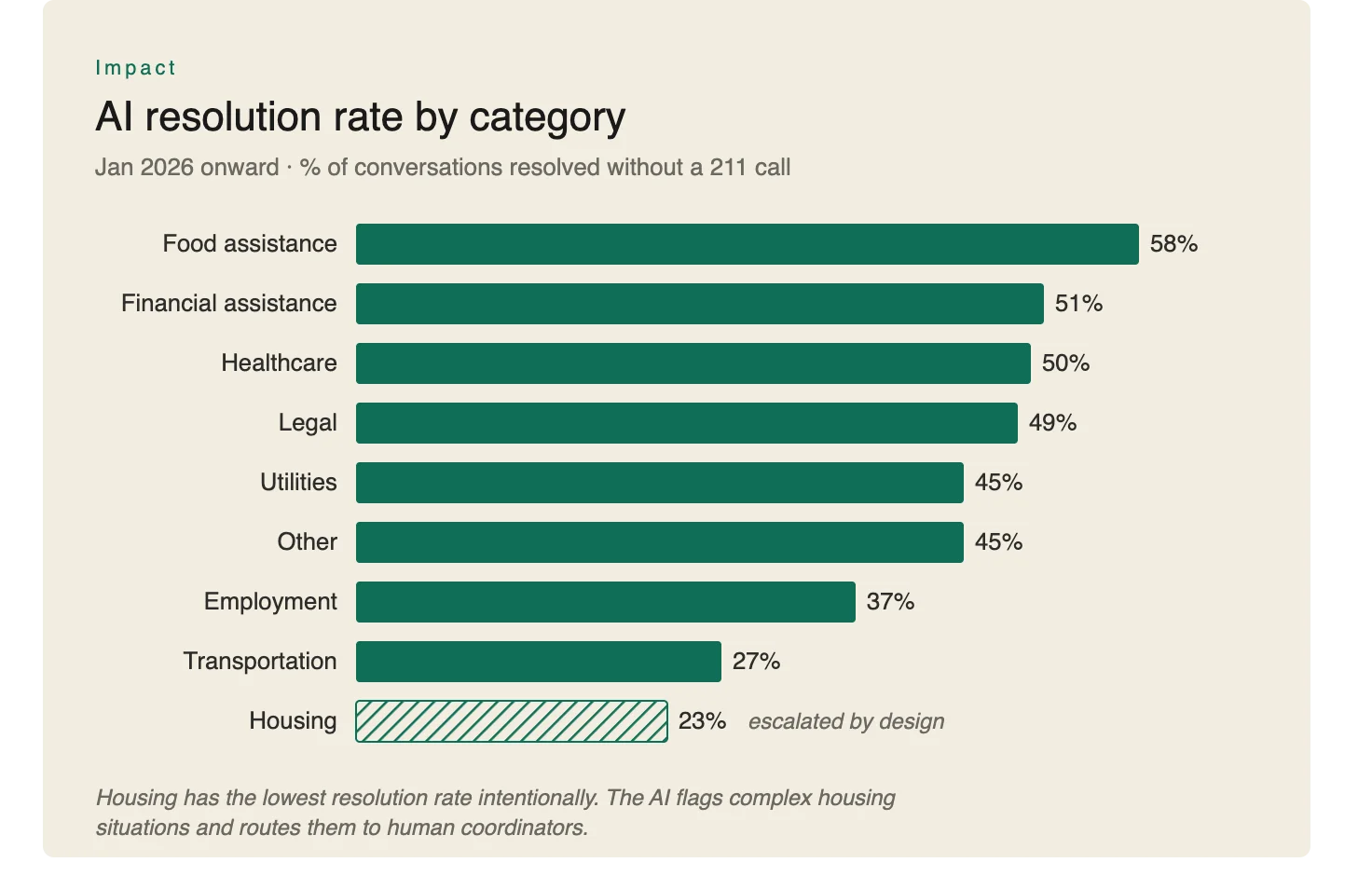
We also worked carefully to understand how many conversations could be resolved end-to-end by Keeper. For 211 Connecticut’s protocols, the rate of Keeper resolved conversations sits at approximately 34%. This is by design. Many situations, especially those involving crises or complexity, are best handled by a trained specialist. For example, the housing intake process is always completed by a 211 contact specialist in Connecticut.
The goal is not to maximize automation, but to ensure that staff is best utilized to provide each person with the right level of support. This means delivering dependable crisis escalation while maintaining strict safety guardrails. When a situation requires immediate human intervention, the system consistently recognizes it and refers the individual to the appropriate support, without failure.
But the true test of any system is how it performs under pressure. In November 2025, disruptions tied to the federal government shutdown affecting SNAP drove a sharp surge in demand at 211 Connecticut almost overnight. Usage of Keeper’s AI Assistant more than doubled, with food-related inquiries increasing nearly tenfold.
Working alongside 211 Connecticut, Keeper Systems implemented targeted protocols to ensure that anyone seeking food assistance received clear, up-to-date guidance based on their situation.
Today, 211 Connecticut can activate custom protocols for high-demand scenarios like this, such as severe weather and urgent events, allowing the operation to scale in the moments that matter most.
Expanding our support
“For many people, accessing support begins with simply knowing how to ask. By introducing a natural language channel, we are removing barriers to entry and making our services more accessible, intuitive, and inclusive. This approach ensures that more residents can connect to the support they need.”
— Leo Pellerin, Chief Information Officer of United Way of Connecticut
With the foundation now in place, our focus is on continuing and deepening this work alongside 211 Connecticut.
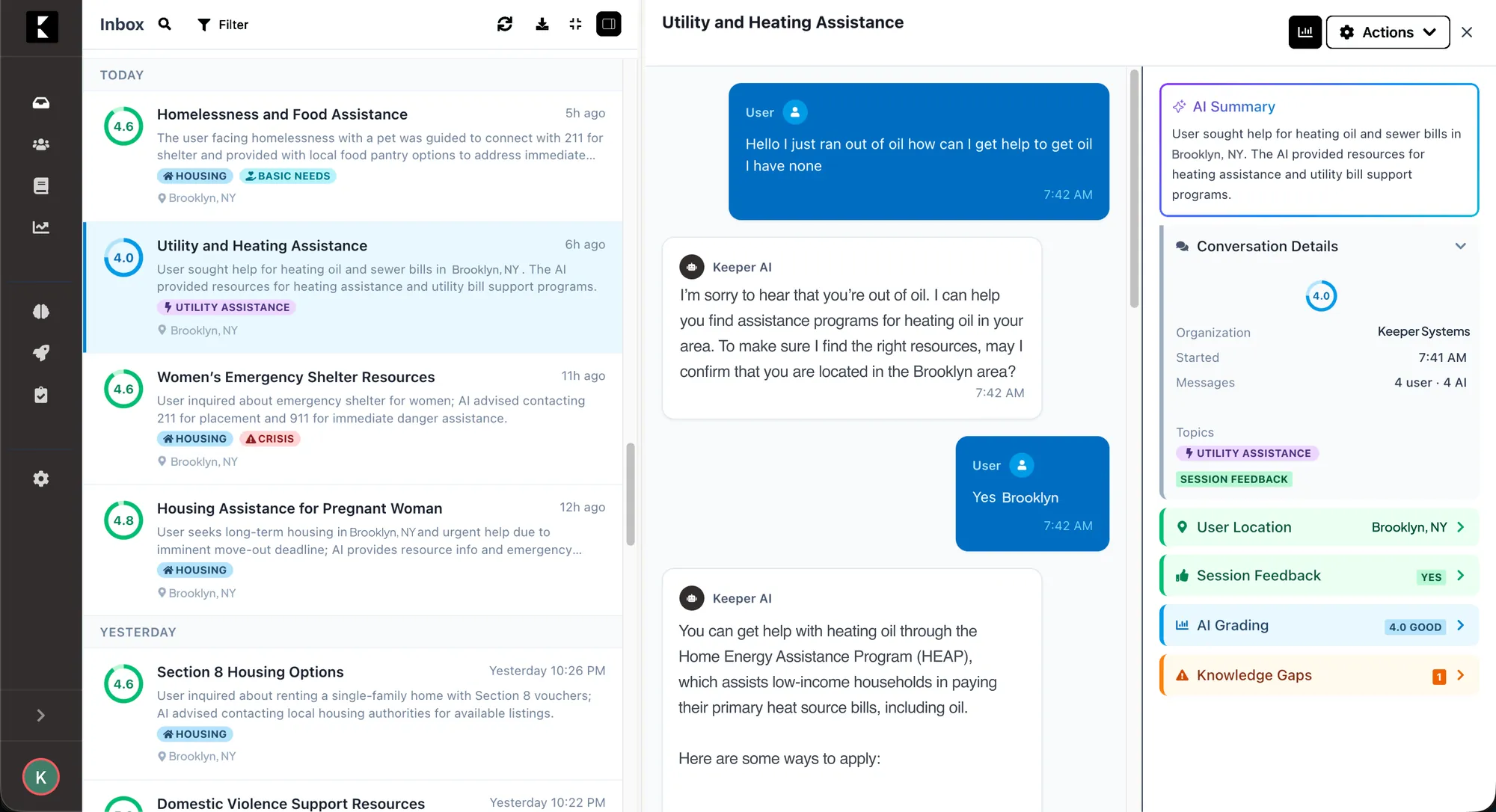
Keeper’s AI platform is not only designed to support people seeking help. It is also helping the 211 CT team better understand community needs in real time. Our analytics tools go beyond simple conversation summaries. They are designed to detect patterns, understand sentiment, and surface insights automatically, giving 211 CT a clearer and more dynamic view of the challenges residents are facing.
To support this, we are making it easier for 211 CT to update both the knowledge and behavior of the AI system, allowing it to become increasingly intelligent, responsive, and better aligned with the needs of people seeking help.
As this partnership continues, we are iterating on the technology, expanding its capabilities, and refining a model for how AI can safely and effectively support community navigation.
Our shared goal is simple: to help ensure that every request for help in Connecticut is heard, understood, and supported.